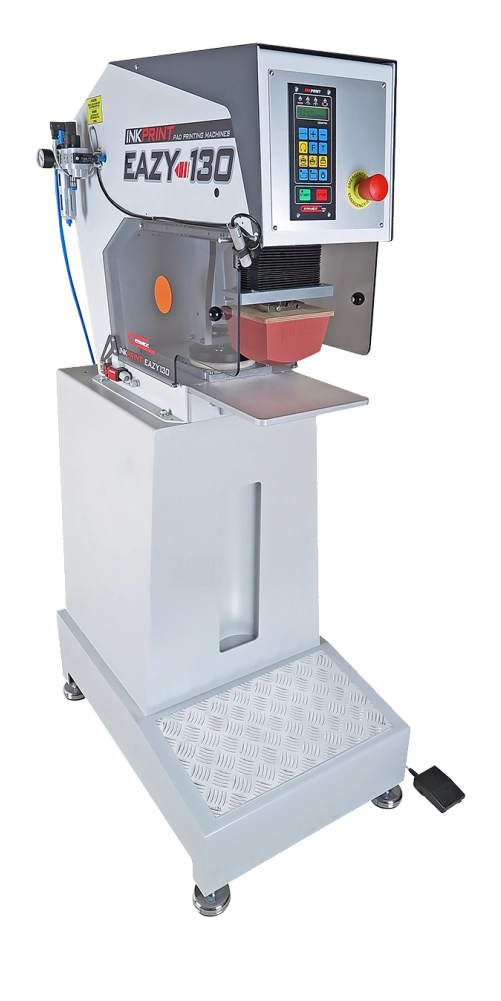
A one-colour pad printing machine for transferring branding, size and fixed care information onto textiles. Let us assess the specifications alongside your…
A one-colour pad printing machine for transferring branding, size and fixed care information onto textiles. Let us assess the specifications alongside your application requirements.
Technical specifications
EAZY130 1C — Printing features and specifications
Printing Features
1C
Number of Colours
1 Colour
Printing Plate Size
150×300 mm
Closed Ink Cup Diameter
Ø130 mm
Maximum Print Area
Ø115 mm
Pad Horizontal Stroke
200 mm (*)
Pad Vertical Stroke
80 mm
RR Cylinder Length
–
Maximum Printing Force
1060 N
Prints per Hour
1000 pieces
Control
Electropneumatic
Power Supply
110/220 Volt
Pneumatic Supply
6 Bar
Width
410 mm
Length
850 mm
Height
660 mm
Weight without Bench
76 kg
(*) The pad horizontal stroke is marked with an asterisk in the TRİ specification table. The relevant equipment configuration is confirmed at the quotation stage.
One-colour textile printing with EAZY130 1C
The Comec Inkprint EAZY130 1C Textile Printing Machine is an electropneumatic solution for one-colour neck labels, branding, sizes and washing instructions. It uses a Ø130 mm closed ink cup, a 150×300 mm printing plate and a maximum Ø115 mm print area. It can also be assessed for underwear and seamless clothing.
The closed cup with a ceramic doctoring ring simplifies colour changes and limits solvent evaporation. A cross laser helps align the product accurately on the table. The control unit adjusts the print process, while the pneumatic system allows independent pressure regulation.
EAZY130 1C can be configured with product-specific tables and has a stated printing speed of 1000 pieces per hour. Actual output depends on loading, artwork, printing cycle and operator workflow.
Optional accessories
Painted steel machine bench with cabinet
Scale
Extended adjustable table support
One-colour and two-colour kits
Accessories are optional. Compatibility of kits with the selected machine and application is confirmed during quotation.
The image represents a textile configuration of the series. Current equipment and product-specific options are confirmed at the quotation stage.
Applications
Neck labels and branding
Fixed size and care information
Small logos on suitable fabrics
Information needed for selection
Print width and length
Fabric composition and garment shape
Colour count and required production volume
Inks & consumables
The printing plate, silicone pad, ink and fixture are selected with the machine for the specific application.
One-colour fabric printing with Comec Inkprint EAZY130 1C
One-colour artwork for Comec Inkprint EAZY130 1C is assessed against its stated maximum 115 mm print area. This value does not guarantee the same result for every artwork shape or fabric: positioning, pad shape and product surface also need assessment.
Tables and supporting equipment
The setup supports the print area evenly on sewn garments or fabric pieces. Plate position, product loading and ink selection are checked through samples. Production volume is considered with operator loading and unloading to define suitable equipment options.
Let us find the right printing solution for your product.
Share your fabric type, print size, colour count and production requirements. We will assess machine and ink selection together.
EAZY130 1C can be assessed for fixed logos, sizes and product information using its 1-colour textile pad printing configuration. Suitability for the examples below depends on the specified print area and a fixture prepared for the actual product.
Tagless printing on T-shirts
Brand, size and fixed care information can be printed directly inside a T-shirt neckline instead of on a sewn-in label. In pad printing, the artwork is prepared on a printing plate and a silicone pad transfers suitable ink onto the fabric. Distance from seams, fabric absorbency and drying conditions are determined together.
Tagless printing on basic T-shirts
Inside-neck information can be printed when the same basic T-shirt is produced for different brands and sizes. Line detail, plate and ink transfer are adjusted together for small-text legibility. Changes in fabric weight or finish require verification of earlier settings on a new sample.
Tagless printing on boxer shorts
Brand, size and fixed product information can be pad printed inside a suitable waistband area on boxer shorts. The fixture must hold the print area flat, preventing elastic and seams from disturbing pad contact. Stretch during wear and washing conditions guide ink and drying selection.
Tagless printing on briefs
Printing size, fibre content or branding inside briefs can reduce the need for a separate label. Artwork size and pad contact are important in narrow areas. Print feel, stretch behaviour and intended wash performance are assessed on the actual garment where the print touches skin.
Tagless printing on vests
Logos and size information can be pad printed onto a flat area inside a vest neckline. Movement in cotton or blended knit fabrics affects definition. A support that holds the garment without excessive tension and an appropriate ink help achieve consistent transfer of small text.
Tagless printing on underwear
Garment shape and print position are considered together when printing brand, size and care information directly onto underwear. Boxer shorts, vests and briefs may differ in fabric and stretch. Each product therefore requires sample printing to determine its fixture, ink formulation and drying arrangement.
Tagless printing on socks
Brand, size and fixed identification markings can be pad printed onto sock soles or suitable knitted areas. A positioning fixture supports consistent placement. Because the surface stretches and experiences friction, both initial appearance and results after washing are checked.
Tagless printing on sports socks
Direct printing can be considered for fixed size, brand or small symbols on sports socks. Raised knit, sole support and tension affect contact. Ink flexibility and abrasion resistance are tested together, and the sample is approved before production.
Tagless printing on leggings
Size and care information can be printed inside a suitable waistband area on leggings. Ink selection considers flexibility as well as adhesion on elastane blends. The print is examined under intended stretch and washing conditions for cracking or lifting.
Tagless printing on sportswear
Small brand markings and fixed identification information on sportswear can be assessed for pad printing. Polyester ratio, elastane content and exposure to perspiration or friction affect process selection. Artwork size and colour count are planned with the machine configuration and fixture.
Tagless printing on team shirts
Inside-neck size information and small fixed logos can be pad printed on suitable team-shirt fabrics. On polyester, both adhesion and the fabric colour’s effect on the print are assessed. Large graphics and small information markings need different areas, so capacity is selected using actual artwork.
Tagless printing on baby clothing
Size and brand information can be printed directly inside the neck or another suitable inner area of baby clothing. Legibility and print feel are assessed together on soft fabrics. Current technical and conformity documents for the ink are reviewed against contact conditions and the customer’s specification when defining the process.
Tagless printing on elastic
Fixed branding and symbols on underwear waistbands or textile elastic tapes can be assessed for pad printing. Fibre and coating structure and expected stretch determine the result. Prints are compared under tension and at rest, with adhesion and wash resistance checked on actual samples.
Tagless printing on private-label products
When the same garment is produced for different brands, fixed logos and size artwork can be managed with separate printing plates. Records of plates, colours and print positions simplify brand changes. Serial numbers or barcodes that change with every impression require a different solution from pad printing with a fixed plate.
Colour and area selection for tagless printing
The specification table lists a maximum Ø115 mm print area for EAZY130 1C. One-colour logos and information are planned within this area. Pad and plate selection are checked with the artwork detail during sample printing.
Tagless textile printing in production
Production planning with EAZY130 1C considers loading, ink transfer and drying time alongside nominal machine speed. Consistent fabric positioning supports repeatable logo and size printing. Plate changes and settings for different sizes or customer brands are managed through recorded production formulations.
Tagless printing on pyjamas and loungewear
Size, brand and fixed care information can be printed inside a suitable neckline or waistband on pyjamas and loungewear. A flat support prevents fabric bunching. Softness requirements, small-text legibility and intended washing conditions are assessed together.
Tagless printing on thermal underwear
Size and brand information can be pad printed onto a suitable inner area of thermal underwear. Fabric stretch and surface structure affect adhesion and print feel. Samples are prepared for the intended use and washing conditions; drying settings also consider the fabric’s response to heat.
Tagless printing on woven tapes
Small logos, symbols or short fixed text can be considered for woven tapes. Tape width, raised weave and support beneath the print determine definition. Positioning the tape in a fixture maintains alignment during repeated printing; ink is selected using the actual surface.
Tagless printing on spread fabric
Print positions for fixed logos and product markings on fabric before cutting are planned with the cutting layout. Machine loading and surface support are assessed for the application. Ink transfer and drying are arranged to suit the next production operation.
Tagless printing on cut fabric pieces
Fixed brand, size or orientation markings can be printed onto cut fabric pieces before sewing. A cut edge or defined reference is used for positioning in the fixture. A production sample confirms that the print will not overlap subsequent seams or folds.
Tagless printing on technical textiles
Fixed product codes, symbols and identification marks can be printed directly onto technical fabrics. Coatings and service conditions such as temperature and friction guide ink selection. Samples are assessed for initial adhesion and durability appropriate to intended use.
Care symbols in tagless fabric printing
Fixed washing, drying and other care symbols can be pad printed onto suitable textile areas. Line thickness and spacing must remain legible at the selected size. Content follows the manufacturer’s approved product information, and the sample is checked before plate preparation.
Fibre content information in tagless printing
Fixed fibre composition and short product information can be printed inside a suitably sized neckline or garment area. Line count and text size are planned with the fabric texture. Plates and production records are organised by product to prevent mixing up text for different fabric blends.
Country-of-origin information in tagless printing
Fixed origin information can be included on the printing plate with a logo and size. Text must follow the approved product information. Rather than squeezing all content into a small area, a sample is prepared considering legible text size and placement together.
Size variations in tagless printing
Fixed sizes such as S, M, L and XL can be managed with separate printing plates or a planned production arrangement. Garment size and printed information are checked at changeover. Fixed-plate printing differs from automatically changing serial numbers or barcode data.
Wash resistance in tagless textile printing
The ink’s specified drying and waiting time must be completed before assessing wash resistance. Temperature, detergent, drying method and cycle count are defined in advance. The original sample is compared with the washed print to assess adhesion, colour and preservation of fine detail.
Drying in tagless textile printing
Drying and any curing conditions follow the ink series’ technical data sheet. Fabric heat response and available production time are considered together. A touch-dry print may not have reached its final resistance, so the required waiting time is also included in the process.
Small-text definition in tagless printing
Line thickness, letter spacing and fabric texture are assessed together for small size and care text. Plate quality, pad contact and ink consistency affect fine-detail transfer. Artwork is considered ready for production only after a sample at the actual print size has been checked for legibility.
Sample approval for tagless printing
The actual fabric, print area and approved artwork are brought together for a trial. Appearance, text legibility, feel and required resistance are assessed on the same sample. Recording the approved ink, plate, pad and drying settings supports repeat production.